
 English
 Français
 Español
 日本語
 العربية
 繁体中文


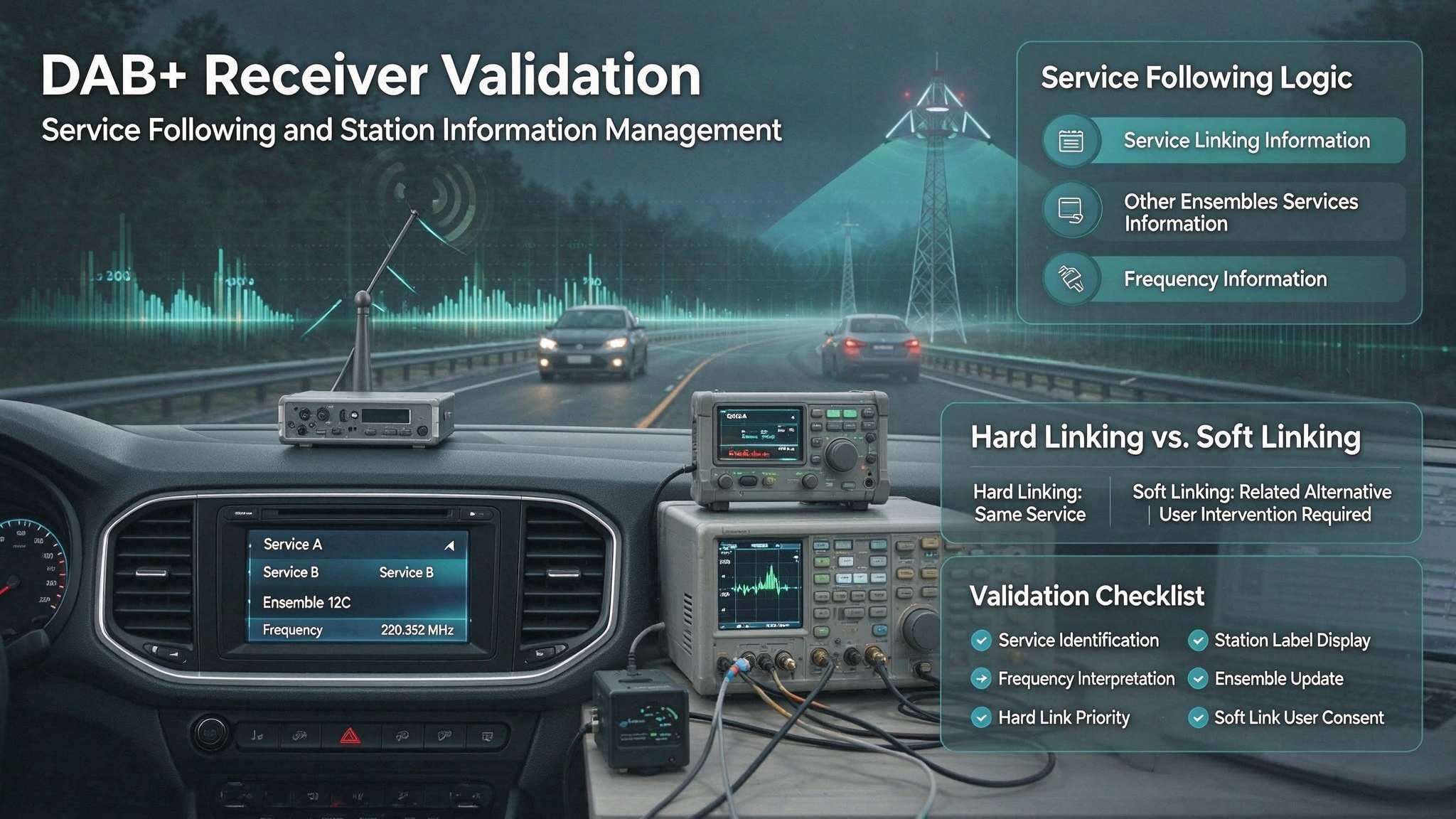
DAB+ Receiver Validation: How to Manage Service Following and Station Information
Contact: [email protected] | WhatsApp: +86 17663606879
For drivers, digital radio should provide a consistent listening experience even when a vehicle moves between different broadcast coverage areas.
For receiver manufacturers and automotive infotainment developers, however, maintaining that experience involves more than simply displaying a list of available stations.
Service identification, frequency information and service-following behaviour all deserve attention during DAB+ receiver development and validation.
1. Understanding DAB+ Service Information
The DAB family of standards includes several specifications covering the transmission system, audio coding, data applications and receiver requirements.
WorldDAB identifies ETSI TS 103 176 as the rules of implementation for service information features.
In a DAB receiver, relevant information can include:
Service identification
Service labels
Ensemble information
Frequency information
Service-linking information
Additional programme information, where supported
These elements help receivers interpret broadcast services and organise the available information.
2. What Is Service Following?
Service Following is designed to maintain access to the same selected audio or data service when reception conditions change.
For example, a vehicle may travel beyond the coverage area of its currently tuned DAB ensemble.
The receiver can use broadcast signalling information to identify possible alternative frequencies or ensembles carrying the selected service.
ETSI TS 103 176 describes three important information categories:
A. Service Linking Information
This information identifies relationships between services and supports the selection of alternative service instances.
B. Other Ensembles Services Information
This helps receivers identify services available on other DAB ensembles.
C. Frequency Information
This provides information about relevant frequencies that may be used when following a service.
Together, these mechanisms support service-following decisions as reception conditions change.
3. Hard Linking vs. Soft Linking
An important distinction in DAB+ receiver implementation is the difference between hard and soft linking.
Hard Linking
Hard linking refers to an alternative carrying precisely the same service.
The receiver should investigate available hard links before considering soft links.
Soft Linking
Soft linking refers to related alternative content rather than an identical service.
According to ETSI TS 103 176, the receiver should request user intervention before following a soft link because the content is not identical.
This distinction matters when evaluating whether a receiver is switching to the same programme service or merely offering a related alternative.
4. Station List and Programme Information Management
A receiver's station information management involves more than storing station names.
Engineering teams may need to examine:
Whether service labels are displayed correctly
Whether service identifiers are associated with the correct stations
Whether frequency information is interpreted correctly
Whether information is refreshed when the broadcast configuration changes
Whether programme and station metadata are displayed consistently
SPI (Service and Programme Information) provides additional information such as service names, identification, frequencies, programme schedules and station logos.
However, WorldDAB describes SPI as an advanced function that is optional in a receiver. Its availability should therefore be considered according to the product specification rather than assumed for every DAB+ device.
5. A Practical DAB+ Receiver Validation Checklist
For automotive receiver projects, the following checks can help organise development and validation:
Service identification
Verify service and ensemble identification.
Check the association between station labels and service identifiers.
Review station-list updates when broadcast information changes.
Service following
Evaluate reception degradation and loss scenarios.
Check whether alternative frequencies and ensembles can be identified.
Verify hard-link handling before soft-link handling.
Check whether user intervention is requested for soft-link selection.
Information management
Review the handling of frequency and service information.
Verify SPI data presentation if the receiver supports SPI.
Check behaviour when information is missing or updated.
These are practical engineering checks. The applicable mandatory receiver requirements and test procedures should be determined from the relevant product specification and applicable ETSI standards.
6. Why This Matters for Automotive Projects
In-vehicle digital radio performance depends on the interaction between broadcast signalling, receiver implementation and changing reception conditions.
A structured validation approach can help identify service-selection issues, incorrect station information and unexpected switching behaviour before product release.
Final Thoughts
DAB+ receiver development requires attention to both signal reception and the way broadcast service information is interpreted and presented.
At Blue Asia, we support automotive electronics projects with DAB+ related testing, EMC testing, wireless certification and other automotive electronics compliance services.
If you are developing DAB+ receivers or in-vehicle infotainment systems, we welcome opportunities to discuss potential technical cooperation.
Contact: [email protected] | WhatsApp: +86 17663606879
 博客
Why Two-Wheelers Are Becoming As Complex As Pa
阅读文章
 博客
Why Future Vehicle Certification Will Be Conti
阅读文章
 博客
Saudi SASO 2944 for Light Vehicles: How to Sep
阅读文章
 博客
Adding 4G/5G eCall to an Existing Vehicle? The
阅读文章
 博客
Apple CarPlay Audio Integration: How to Avoid
阅读文章
 博客
DAB+ Receiver Validation: How to Manage Servic
阅读文章

 4000259520