
 English
 Français
 Español
 日本語
 العربية
 繁体中文


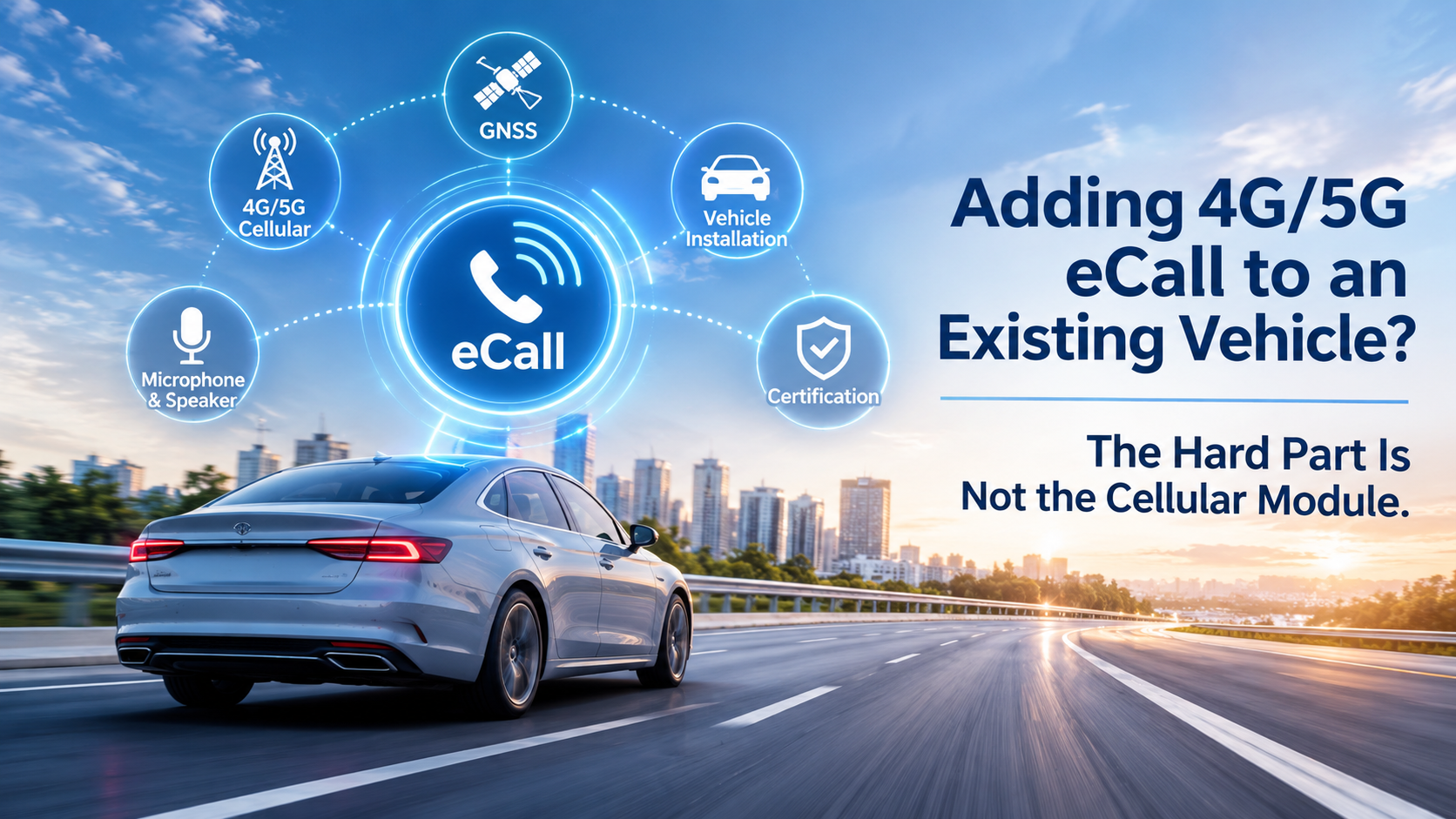
Adding 4G/5G eCall to an Existing Vehicle? The Hard Part Is Not the Cellular Module.
Adding 4G/5G eCall to an Existing Vehicle? The Hard Part Is Not the Cellular Module.
The cellular module passed its test.
The eCall device passed RF validation.
The GNSS works on the bench.
So why can an aftermarket eCall installation still fail when it is integrated into a real vehicle?
This is becoming a more important question as Europe moves from legacy circuit-switched eCall toward packet-switched 4G/5G eCall.
Since January 1, 2026, new M1/N1 vehicle types in the EU need to support eCall via packet-switched networks, including 4G/5G. At the same time, the European Commission is explicitly identifying the aftermarket opportunity and the need for requirements covering physical installation, operational performance and certification of aftermarket eCall devices.
For automotive manufacturers and eCall device suppliers, this changes the engineering question.
It is no longer simply:
“Is our 4G/5G eCall module compliant?”
The better question is:
“Will the complete eCall installation perform correctly after it is installed in this vehicle?”
A 4G/5G eCall Retrofit Is a System, Not a Modem
A typical aftermarket eCall architecture looks like this:
Cellular Module
↓
IMS / Packet-Switched Network
↓
GNSS
↓
MSD Generation
↓
Microphone / Speaker
↓
Antenna System
↓
Vehicle Power Supply
↓
Vehicle Installation
↓
Emergency Trigger
↓
PSAP
Every block can affect the final result.
This is why replacing a 2G/3G module with a 4G/5G module is not automatically an NG-eCall solution.
The European eCall framework already includes standards for IMS-based packet-switched eCall, end-to-end conformance testing, interoperability and operating requirements. The 2026 EU planning documents also highlight the need for additional standards and testing for aftermarket devices.
Where Can an Aftermarket eCall System Fail?
1. Cellular Module ≠ Network Compatibility
A module may support LTE or 5G, but eCall requires more than basic cellular registration.
The engineering team needs to examine:
IMS registration
Packet-switched eCall support
Network compatibility
Emergency-call routing
Voice path
Data transmission
SIM/eSIM configuration
Network fallback behavior
Regional operator conditions
A device that successfully attaches to a commercial network is not necessarily a device that can complete the required emergency communication path.
2. GNSS Performance Changes After Installation
GNSS performance can be very different inside a vehicle.
The final result depends on:
Antenna location
Antenna gain
Ground plane
Vehicle roof/body structure
Cable loss
Nearby electronics
Cellular transmission
RF interference
Installation orientation
A GNSS antenna that performs well on a laboratory bench may behave differently once installed behind a dashboard or inside a metal vehicle structure.
3. MSD Must Be Correct — Not Just Generated
The Minimum Set of Data (MSD) is one of the most important parts of eCall.
The system must correctly determine and transmit relevant information such as:
Vehicle identification
Location
Direction
Timestamp
Trigger information
Other applicable emergency data
The question is not only:
“Can the device generate MSD?”
It is:
“Does the complete system generate the correct MSD at the correct time and transmit it successfully through the required communication path?”
That distinction matters during end-to-end validation.
4. The Vehicle Installation Can Change RF and EMC Performance
This is where many aftermarket projects underestimate the engineering work.
Installing an eCall device means connecting it to a real vehicle environment.
You may now have:
Vehicle Battery → DC/DC → eCall Device → Cellular RF → GNSS → Audio → CAN/Trigger Interface
The installation can introduce:
Power transients
Grounding problems
Conducted noise
Radiated interference
Antenna coupling
Cable coupling
RF desense
Audio interference
EMC failures
Unexpected resets
The device may have passed standalone RF Testing and EMC Testing, but vehicle installation can create a different electromagnetic environment.
This is why aftermarket eCall validation should not stop at the module certificate or laboratory report.
Aftermarket eCall Pre-Validation Checklist
Before putting an aftermarket 4G/5G eCall device into a vehicle validation program, I recommend reviewing at least these areas:
| Area | Key Question |
|---|---|
| Cellular | Does the device support the required packet-switched / IMS eCall architecture? |
| Network | Can the emergency communication path be established in the target market? |
| GNSS | Is positioning reliable after actual vehicle installation? |
| MSD | Is the required emergency data generated correctly? |
| Audio | Can the microphone and speaker maintain a reliable two-way connection? |
| Antenna | Are cellular and GNSS antennas correctly positioned and isolated? |
| Power | Can the device survive vehicle power fluctuations and emergency-operation requirements? |
| EMC | Can the device coexist with the vehicle's electrical environment? |
| Trigger | Can automatic/manual emergency triggering work reliably? |
| Vehicle Interface | Are CAN, crash signals or other interfaces correctly integrated? |
| Software | Are firmware, configuration and network parameters controlled? |
| End-to-End | Can the complete system successfully complete the emergency communication chain? |
This checklist is more useful than simply asking:
“Does the module have an LTE certificate?”
Do Not Confuse Four Different Compliance Questions
For aftermarket eCall projects, I recommend separating these four questions:
① Cellular / RF Compliance
Does the radio hardware comply with the applicable telecommunications requirements?
② eCall System Compliance
Does the eCall implementation meet the applicable technical requirements for emergency communication?
③ Vehicle Installation Validation
Does the system continue to perform correctly after installation into the target vehicle?
④ Market / Certification Requirements
What evidence and certification route is required for the specific product, vehicle category and target market?
These are related—but they are not the same compliance question.
What Should eCall Device Manufacturers Prepare?
For an eCall ECU, T-Box, telematics unit or aftermarket eCall device, I would recommend creating a configuration baseline covering:
Cellular Module
→ Modem Firmware
→ IMS Configuration
→ SIM/eSIM
→ GNSS Module & Antenna
→ Cellular Antenna
→ Microphone / Speaker
→ Power Supply
→ Vehicle Interface
→ Trigger Logic
→ MSD Software
→ Vehicle Installation
→ Validation Evidence
Why?
Because changing the cellular module, antenna, firmware, GNSS antenna, power architecture or vehicle interface can change the validation result.
A new hardware configuration should therefore trigger an impact assessment, rather than automatically assuming that the previous evidence remains fully valid.
The Bigger Opportunity: Aftermarket eCall
The European Commission's 2026 eCall planning work specifically recognizes an aftermarket opportunity as networks and PSAP infrastructure become operational. At the same time, it highlights the challenge of controlling the performance and quality of aftermarket devices and calls for standards covering physical parameters, installation, operational performance and certification.
The European Commission also published a 2026 study on the legacy eCall fleet and possible mitigation approaches, including software upgrades and aftermarket solutions, as 2G/3G networks are retired.
That means aftermarket eCall should not be viewed simply as:
“Replace the old modem.”
It is becoming an automotive system integration and validation problem.
Where BlueAsia Can Help
At BlueAsia, we see eCall projects from the product—not just the certificate—perspective.
Our capabilities connect:
RF Testing
Cellular / Wireless Validation
GNSS
EMC Testing
Automotive Electronics
eCall Compliance
Vehicle-Level Pre-Validation
This is particularly relevant for:
eCall ECU manufacturers
T-Box suppliers
Telematics device manufacturers
Automotive aftermarket brands
Connected vehicle manufacturers
Vehicle electronics suppliers
Automotive OEM and Tier 1 development teams
Instead of discovering at the final certification stage that the problem comes from RF, antenna, EMC, power, firmware, GNSS or vehicle integration, the objective is to identify the risk earlier.
My Recommendation to Automotive Teams
If you are planning a 4G/5G eCall retrofit, do not start with:
“Which cellular module should we certify?”
Start with:
“What happens to the complete eCall system after this device is installed in the vehicle?”
That change in thinking can prevent a significant amount of late-stage troubleshooting and retesting.
A compliant eCall module does not automatically create a compliant eCall vehicle installation.
For aftermarket eCall, the module is only the beginning.
If your team is developing a 4G/5G eCall device, T-Box, telematics ECU or aftermarket connected-vehicle solution, BlueAsia can help review the RF, EMC, GNSS, cellular, vehicle-integration and compliance evidence before formal testing.
Contact BlueAsia Labs to discuss your eCall retrofit project and pre-validation plan.
 博客
Why Two-Wheelers Are Becoming As Complex As Pa
阅读文章
 博客
Why Future Vehicle Certification Will Be Conti
阅读文章
 博客
Saudi SASO 2944 for Light Vehicles: How to Sep
阅读文章
 博客
Adding 4G/5G eCall to an Existing Vehicle? The
阅读文章
 博客
Apple CarPlay Audio Integration: How to Avoid
阅读文章
 博客
DAB+ Receiver Validation: How to Manage Servic
阅读文章

 4000259520