
 English
 Français
 Español
 日本語
 العربية
 繁体中文

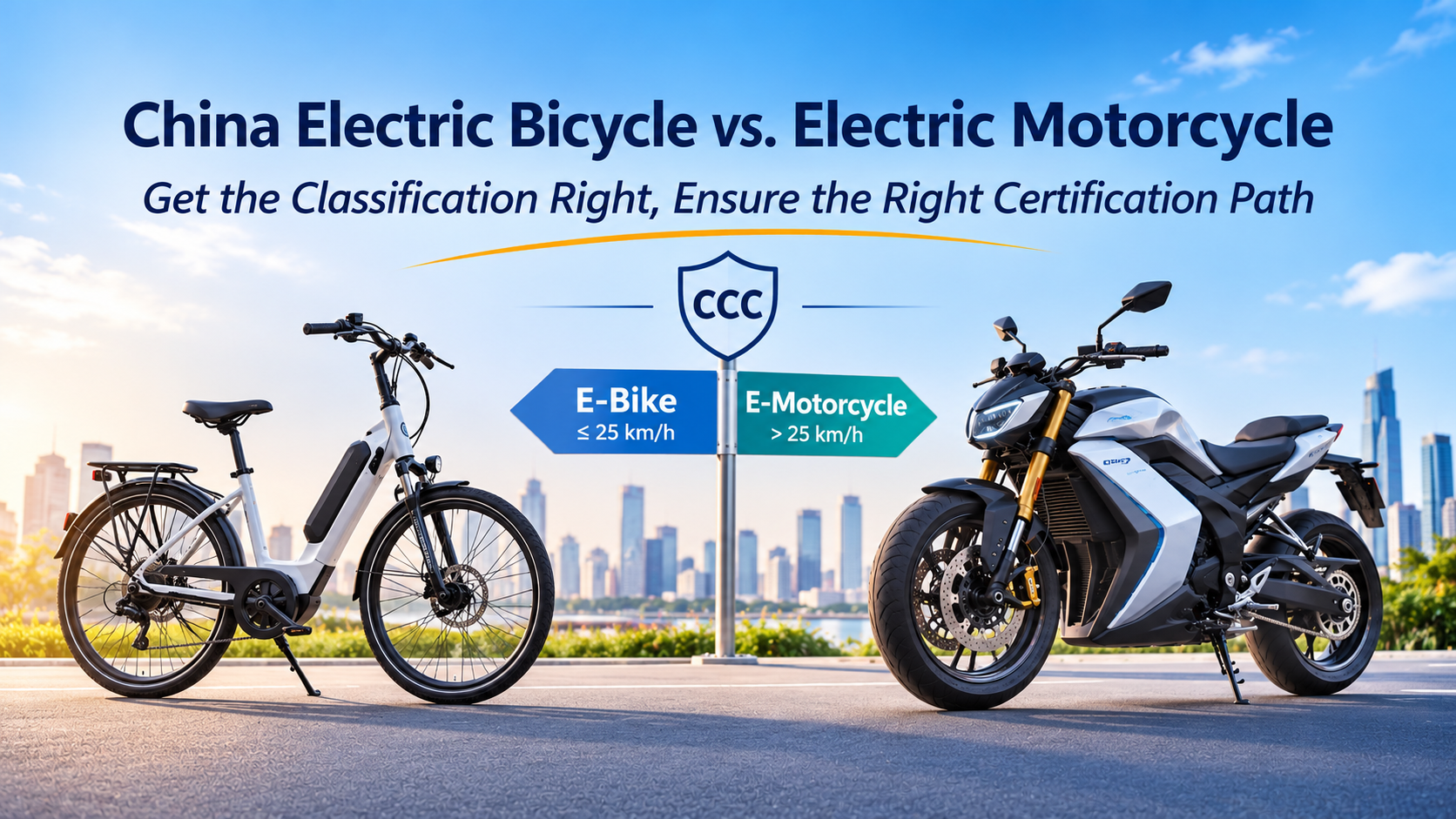
China Electric Motorcycle vs. E-Bike: Why Vehicle Classification Determines the Entire Certification Path
A few extra kilometres per hour can completely change your certification strategy.
For manufacturers developing electric motorcycles and electric bicycles for the Chinese market, one of the most expensive mistakes is to treat vehicle classification as something that can be solved after the prototype is finished.
It cannot.
If a product is designed as an electric bicycle (e-bike) but no longer satisfies the applicable requirements of GB 17761-2024, it cannot simply continue using the e-bike compliance route.
The consequences can extend from CCC certification and product standards to vehicle type approval, production access, registration and road-use requirements.
For export manufacturers, getting the classification right at the design stage is therefore a compliance decision—not just a product-design decision.
1. E-Bike and Electric Motorcycle Are Not Two Versions of the Same Product
China treats electric bicycles and electric motorcycles under different regulatory frameworks.
An electric bicycle is a non-motor vehicle. Its current technical framework is based on GB 17761-2024, which came into force on September 1, 2025.
Electric motorcycles, by contrast, are motor vehicles and fall under the motorcycle regulatory and certification system.
China's current compulsory certification catalogue separately lists:
Motorcycles — CNCA-C11-02
Electric bicycles — CNCA-C11-16
The separation is not merely administrative. The certification systems are fundamentally different.
This is why changing the vehicle's speed, motor configuration or electrical architecture late in development can create a much larger compliance problem than expected.
2. The First Design Question: “Is This Still an Electric Bicycle?”
Under GB 17761-2024, an electric bicycle with electric drive must have a maximum design speed of no more than 25 km/h. When the vehicle exceeds 25 km/h, the motor must stop providing driving power.
Other important technical boundaries also exist.
Current Chinese regulatory materials identify requirements including:
Maximum design speed: ≤25 km/h
Rated motor power: ≤400 W
Maximum battery-system voltage: ≤60 V
Vehicle mass requirements
Pedal-riding capability / applicable design requirements
The exact mass requirements differ depending on the battery technology under GB 17761-2024, so manufacturers should not continue using the old 55 kg / 48 V rule as a universal description of the current standard.
This distinction is important for engineering teams.
A product that exceeds one or more applicable e-bike boundaries cannot simply be “certified as an e-bike anyway.”
The manufacturer needs to reassess the vehicle category and applicable certification route.
3. Why “Just Increase the Speed” Can Break the Entire Certification Plan
Consider two products that look almost identical.
Product A
25 km/h design speed
E-bike configuration
E-bike battery and charger
E-bike CCC pathway
Non-motor vehicle positioning
Product B
Higher design speed
Higher-power drive system
Motorcycle-style vehicle architecture
Motorcycle regulatory pathway
The differences may appear small from a product-marketing perspective.
From a compliance perspective, they can be substantial.
The second product may require a motorcycle CCC pathway and the associated motorcycle technical requirements, rather than the electric-bicycle CCC pathway.
CNCA's motorcycle certification rules apply to motorcycles operating on Chinese public roads, with certification based on applicable safety, environmental, energy-saving and anti-theft requirements.
Therefore, the question should not be:
“Can we make this e-bike slightly faster?”
It should be:
“Which vehicle category are we designing this product to comply with?”
4. Classification Must Be Frozen Before the Prototype Is Frozen
For manufacturers, we recommend establishing a Vehicle Classification Matrix at the beginning of development.
Review at least:
| Parameter | E-Bike Design Review | Motorcycle Design Review |
|---|---|---|
| Vehicle category | Electric bicycle | Motorcycle / electric motorcycle |
| Design speed | ≤25 km/h | Depends on applicable motorcycle category |
| Motor power | Within e-bike limits | Motorcycle requirements |
| Battery voltage | Within applicable e-bike limits | Motorcycle architecture |
| Vehicle mass | GB 17761-2024 | Applicable motorcycle requirements |
| CCC route | E-bike CCC | Motorcycle CCC |
| Vehicle registration | Non-motor vehicle | Motor vehicle |
| Road-use requirements | E-bike rules | Motorcycle rules |
| Product changes | GB 17761 consistency | Motorcycle type-approval consistency |
The exact motorcycle category must then be determined from the vehicle's technical configuration and applicable Chinese vehicle-classification rules.
5. The Biggest Trap: Designing for Export First, Certification Later
This happens frequently with international brands.
An overseas product may originally be designed around:
45 km/h or 50 km/h
Large battery
High-power motor
Motorcycle-style frame
Integrated TFT display
Bluetooth/Wi-Fi
Cellular connectivity
Smartphone application
Advanced BMS
Large DC/DC system
Then the manufacturer decides to create a “China e-bike version.”
The team may reduce the speed setting through software and assume the problem is solved.
This is risky.
Certification is not based simply on a marketing speed setting.
The vehicle's hardware, software, motor characteristics, battery system, electrical architecture, structure and other applicable technical requirements must be evaluated against the intended product category.
China's authorities have also specifically strengthened anti-tampering and consistency requirements under GB 17761-2024.
6. Connectivity Does Not Change the Vehicle Category—But It Can Change the Test Configuration
Modern electric two-wheelers increasingly include:
Bluetooth + Wi-Fi + GNSS + 4G + display + app + OTA + BMS + smart controller
These functions do not automatically turn an e-bike into a motorcycle.
However, they can significantly affect the compliance work.
For example:
EMC
The interaction between:
battery → BMS → controller → motor → DC/DC → display → wireless module
can create conducted and radiated emissions.
Wireless
The final antenna, enclosure and installation position can affect RF performance.
A module's existing radio approval does not automatically mean the complete vehicle's wireless configuration is compliant for every applicable market requirement.
Electrical safety
Connected functions may introduce additional power supplies, converters, communication interfaces and charging configurations.
Cybersecurity
If the vehicle supports OTA, cellular communication, remote control or cloud connectivity, cybersecurity should be considered during architecture design rather than after CCC testing.
This is particularly important for manufacturers planning both China and EU versions of the same platform.
7. China CCC Certification Is Not the Same as EU Type Approval
Another common mistake is assuming that once the Chinese product classification is settled, the same configuration can simply be exported.
It cannot.
A China electric bicycle may follow the GB 17761-2024 + China CCC pathway, while an EU-bound L-category vehicle can fall under a completely different type-approval framework.
For example, an EU connected motorcycle may require assessment involving:
L-category type approval
UN R10 EMC
Wireless/RF requirements
UN R155 cybersecurity
Battery requirements
Vehicle-level integration
Other applicable EU technical requirements
Therefore, manufacturers developing global products should create a China configuration and EU configuration matrix rather than assuming one certificate covers both markets.
8. The New China E-Bike Rules Make Product Consistency Even More Important
This issue has become more important since the implementation of GB 17761-2024.
The new standard introduced additional requirements around safety, materials, electrical systems, anti-tampering and product consistency.
China also updated the CCC implementation rules for electric bicycles in 2026. From November 1, 2026, certification activities are to follow the new 2026 implementation rules, with existing valid certificates transitioning through change, renewal and other natural processes.
For manufacturers, this means the certified configuration should be controlled carefully.
Changing:
Motor
Battery
Charger
Controller
Display
Communication module
Software
Structural components
may trigger a compliance review depending on the applicable certification requirements.
9. What Manufacturers Should Decide Before Tooling
Before finalising tooling and mass-production hardware, ask:
1. Is the product legally intended to be an electric bicycle or a motorcycle?
2. Does the planned speed, motor, voltage, mass and architecture remain within the intended category?
3. Which CCC implementation rule and applicable standards apply?
4. Will the same hardware be sold in China and Europe?
5. Which components can be shared globally, and which must be market-specific?
6. Is the wireless/EMC architecture already designed around the final vehicle configuration?
These questions should be answered before certification testing—not after a test failure.
Build the Certification Path Into the Product Design
The most efficient approach is not:
Design → Prototype → Test → Discover Classification Problem → Redesign
A better approach is:
Vehicle Classification → Regulatory Gap Assessment → Architecture Design → Prototype → Pre-Compliance → Formal Certification → Production Control
At BlueAsia Labs, we support electric mobility and connected vehicle projects through EMC, RF, Bluetooth, IoT performance, electrical safety and automotive compliance testing.
For manufacturers developing electric motorcycles, electric bicycles or connected two-wheelers for China and international markets, our team can help review the product architecture early and identify whether the planned configuration is aligned with the intended certification pathway.
The most expensive compliance problem is often not a failed test. It is choosing the wrong certification route after the product has already been designed.
 博客
Distinguishing Android Auto from Android Autom
阅读文章
 博客
Defining DAB+ Requirements Before Starting an
阅读文章
 博客
Why Vehicle Type Approval Starts Before The Fi
阅读文章
 博客
Why Automotive Certification Is Becoming a Sof
阅读文章
 博客
China Electric Motorcycle vs. E-Bike: Why Vehi
阅读文章
 博客
Your Vehicle Passed Type Approval. Can an OTA
阅读文章

 4000259520