
 English
 Français
 Español
 日本語
 العربية
 繁体中文


Distinguishing Android Auto from Android Automotive OS at Project Start
Olivia | Blue Asia
Email: [email protected]
WhatsApp: +86 176 6360 6879
When planning an automotive infotainment project, one question should be clarified early:
Are you developing for Android Auto, Android Automotive OS (AAOS), or both?
Although these platforms share the Android ecosystem, they serve different purposes and operate in different environments.
For automotive OEMs, Tier 1 suppliers and infotainment manufacturers, understanding this distinction at the beginning can help avoid unnecessary assumptions in system architecture, software development and project validation.
1. What Is Android Auto?
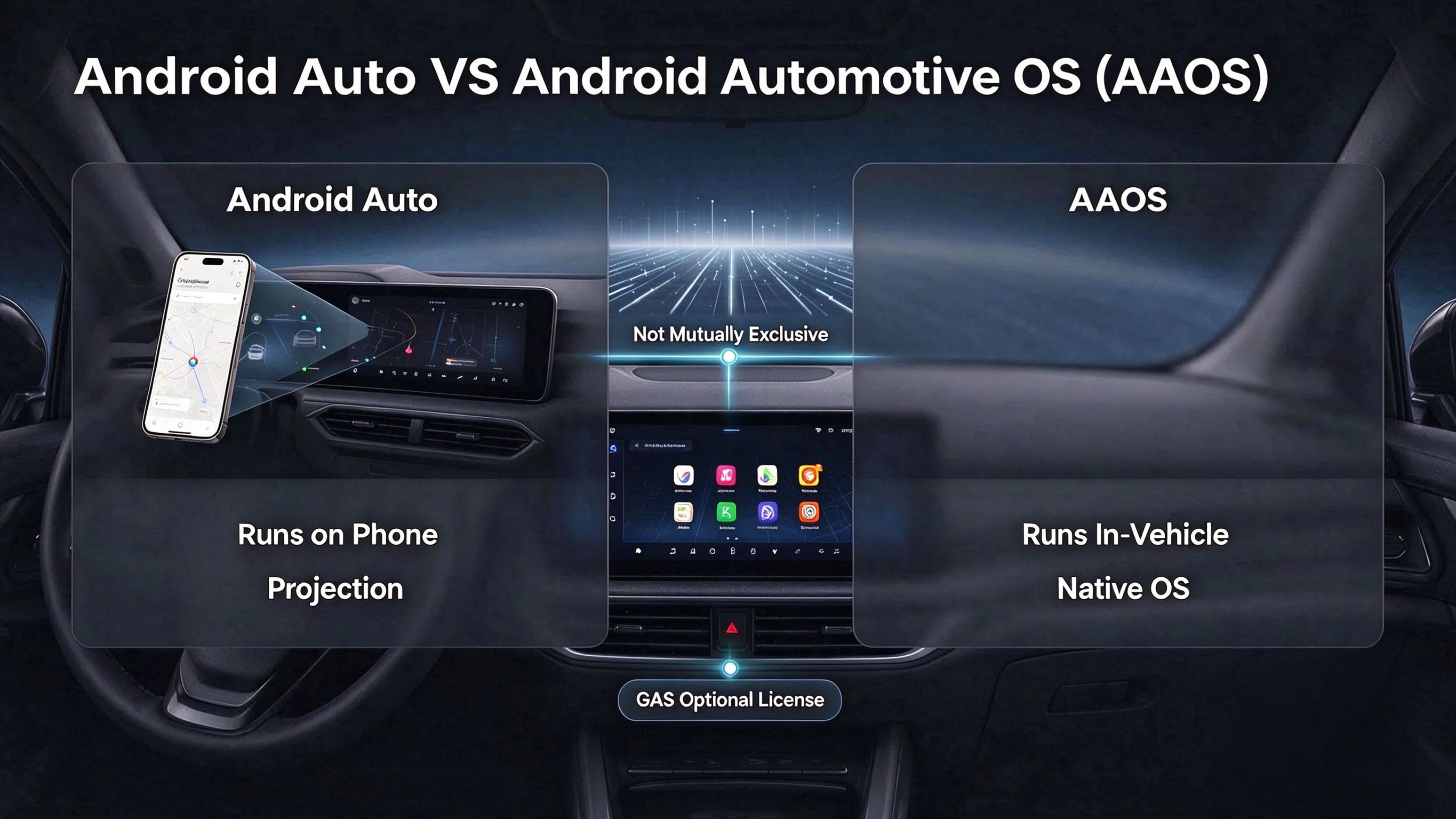
Android Auto provides a driver-optimized app experience by connecting a compatible Android smartphone to a compatible vehicle infotainment system or aftermarket head unit.
The application runs on the user's phone, while the Android Auto experience is presented on the vehicle's display.
From a project perspective, this means that Android Auto integration involves both the mobile application and the vehicle's infotainment environment.
According to Google's official developer documentation:
Android Auto works with compatible Android phones and vehicle infotainment systems.
Applications provide driver-optimized experiences through supported Android Auto integration.
Different app categories have their own development and integration requirements.
This approach allows users to access supported mobile applications through their vehicle displays without requiring the vehicle itself to run Android as its operating system.
2. What Is Android Automotive OS (AAOS)?
Unlike Android Auto, Android Automotive OS is an Android-based operating system built directly into the vehicle's hardware.
It provides a platform for automotive infotainment systems, allowing applications to run directly on the vehicle rather than relying on a connected smartphone.
For automotive manufacturers, AAOS offers a different level of integration with the vehicle's infotainment architecture.
Key characteristics include:
An Android-based operating system running on in-vehicle hardware.
Support for automotive infotainment applications.
The ability to integrate system-level and third-party applications.
Customization opportunities for vehicle manufacturers.
Google's Android Open Source Project documentation also describes Android Automotive as a platform that can support broader Software-Defined Vehicle (SDV) development.
3. Key Differences at a Glance
Understanding the architectural differences is important before defining development and validation requirements.
Android Auto
Runs on the user's smartphone.
Connects to a compatible vehicle infotainment system.
Projects a driver-optimized application experience.
Depends on compatible phone and head-unit integration.
Android Automotive OS
Runs directly on vehicle hardware.
Provides an in-vehicle operating system environment.
Allows applications to be installed and executed within the vehicle.
Requires an automotive-specific software and hardware platform.
One important point: Android Auto and Android Automotive OS are not mutually exclusive.
A vehicle can support AAOS as its built-in infotainment operating system while also offering Android Auto connectivity.
Therefore, supporting one platform should not automatically be interpreted as supporting the other.
4. Where Does Google Automotive Services (GAS) Fit In?
Another term frequently encountered in automotive Android projects is Google Automotive Services (GAS).
GAS is a collection of Google applications and services that automotive OEMs can choose to license and integrate into their infotainment systems.
It is important to distinguish the three concepts:
Android Auto: A phone-based projection platform.
Android Automotive OS: An operating system running directly on vehicle hardware.
Google Automotive Services: A collection of Google applications and services available for licensing and integration.
These terms are related, but they are not interchangeable.
For OEMs planning an Android-based infotainment system, defining the required platform and service scope is an important early project decision.
5. What Should Be Checked Before Starting Development?
Before moving into implementation, automotive engineering and project management teams should consider the following checklist.
1. Confirm the Target Platform
Determine whether the project requires Android Auto, AAOS or both.
Why it matters: The platforms have different operating environments and integration approaches.
2. Define the Hardware Architecture
Confirm whether the infotainment system relies on a connected smartphone or runs an Android-based operating system directly on the vehicle.
Why it matters: This affects system architecture and development responsibilities.
3. Review Application Compatibility
Identify the intended application categories and check their respective platform requirements.
Why it matters: Not every application category is supported in exactly the same way across both platforms.
4. Clarify Google-Related Service Requirements
Determine whether the project requires GAS in addition to the underlying Android Automotive platform.
Why it matters: GAS involves a separate licensing and integration consideration.
5. Establish the Validation Scope
Define the software version, hardware configuration, connectivity functions and applicable project verification requirements.
Why it matters: Early alignment helps ensure that testing reflects the actual product configuration.
These are project-planning recommendations based on the platform differences, rather than additional certification requirements imposed by the Android documentation.
6. Why Early Platform Alignment Matters
In automotive infotainment development, platform selection influences more than the software interface.
It can also affect hardware configuration, application integration, connectivity architecture and the overall verification plan.
For OEMs and Tier 1 suppliers, clarifying these requirements early helps create a more structured development and validation process.
At Blue Asia, we work in electronic product testing, automotive-related compliance and global market access.
For automotive connectivity projects involving Android Auto, CarPlay, DAB+ and related technologies, our team can discuss potential testing and compliance support according to the project scope.
Working on an automotive connectivity project?
Feel free to contact us to discuss your technical and market-access requirements.
Olivia | Blue Asia
Email: [email protected]
WhatsApp: +86 176 6360 6879
 博客
Distinguishing Android Auto from Android Autom
阅读文章
 博客
Defining DAB+ Requirements Before Starting an
阅读文章
 博客
Why Vehicle Type Approval Starts Before The Fi
阅读文章
 博客
Why Automotive Certification Is Becoming a Sof
阅读文章
 博客
China Electric Motorcycle vs. E-Bike: Why Vehi
阅读文章
 博客
Your Vehicle Passed Type Approval. Can an OTA
阅读文章

 4000259520