
 English
 Français
 Español
 日本語
 العربية
 繁体中文


Why Smart Cockpit Projects Fail Because Of System Integration—Not Hardware
Why Smart Cockpit Projects Fail Because Of System Integration—Not Hardware
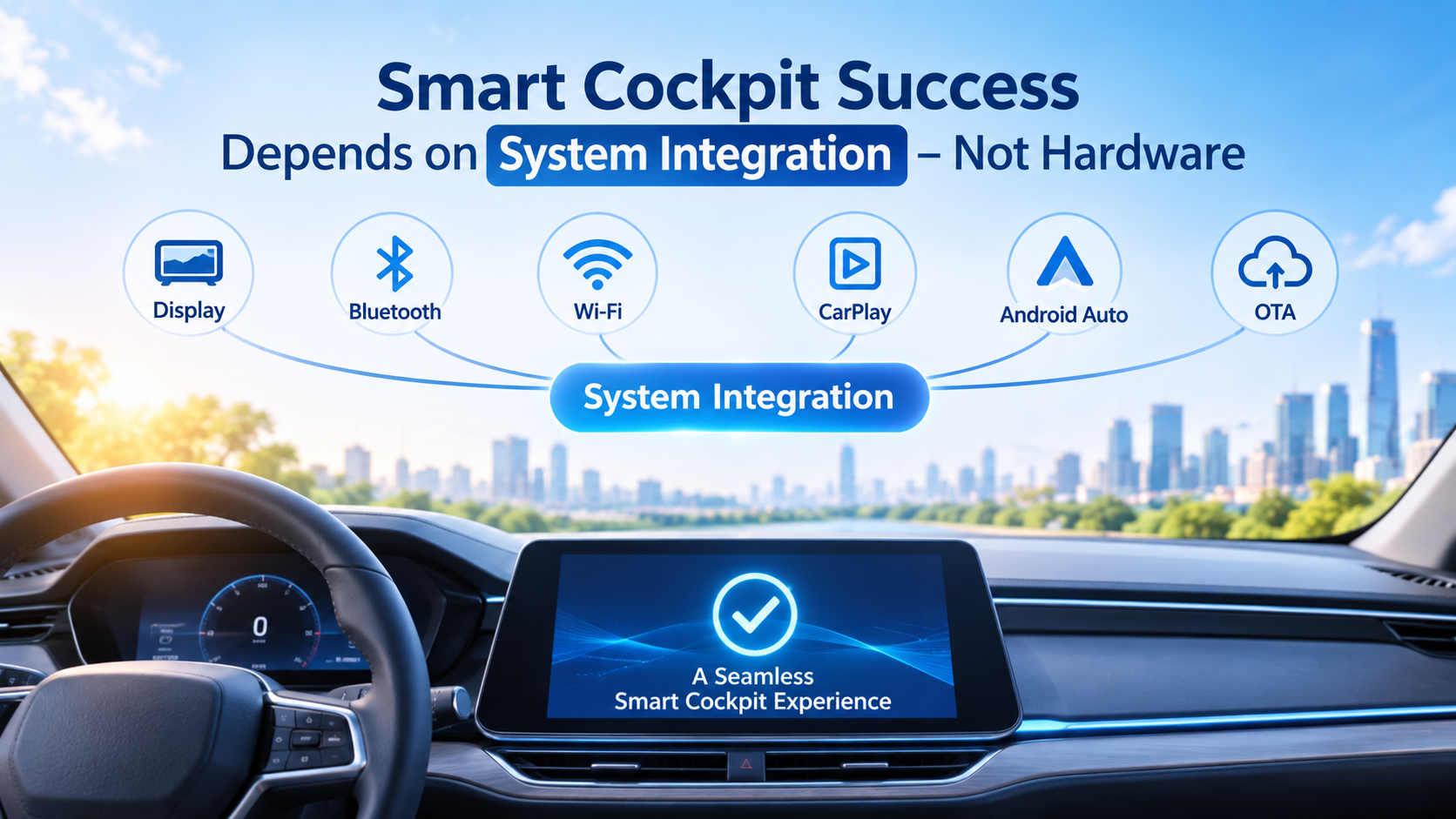
Your display works.
Your Bluetooth works.
Your Wi-Fi works.
The cockpit still fails.
This sounds impossible.
If every individual subsystem passes its own validation, shouldn't the entire smart cockpit work?
Not necessarily.
One of the biggest challenges in modern Smart Cockpit development is that the vehicle is no longer evaluated as a collection of independent components.
It is evaluated as one connected user experience.
And that means System Integration has become just as important as hardware performance.
Modern smart cockpits are no longer simple infotainment systems
A few years ago, an infotainment system mainly handled music, navigation and radio.
Today's smart cockpit is dramatically different.
It may include:
Digital instrument clusters
Touchscreen displays
Voice assistants
Wireless Apple CarPlay
Android Auto
Bluetooth connectivity
Wi-Fi communication
Navigation
Cloud services
OTA updates
Driver personalization
AI-powered features
Every function shares computing resources, software platforms and communication interfaces.
This creates a level of integration complexity that did not exist before.
Individual components can pass while the system still fails
Many engineering teams validate each subsystem separately.
Bluetooth performs well.
Wi-Fi meets specifications.
The display is responsive.
Audio quality is excellent.
From a component perspective, everything looks successful.
But once these systems begin operating together, new problems appear.
For example:
Wireless CarPlay disconnects during Bluetooth audio switching.
Android Auto performance drops while navigation is updating.
Voice assistants respond slowly after an OTA update.
System startup time increases after new software features are added.
Multiple background services compete for processing resources.
None of these issues belong to one component alone.
They are integration issues.
Timing is becoming a hidden engineering challenge
In modern cockpit systems, success depends not only on what functions are running.
It also depends on when they run.
A slight delay in one software task may affect several others.
Examples include:
Audio synchronization
Wireless communication timing
Display rendering
Voice processing
Application startup
Each subsystem may meet its own timing requirements.
Yet the complete user experience can still feel unstable.
This is why software scheduling is becoming just as important as hardware design.
Resource sharing changes everything
Modern cockpit platforms often rely on:
Central computing
Shared processors
Common memory
Shared wireless modules
Unified operating systems
These shared resources improve efficiency.
They also create dependencies.
A software update designed to improve one feature may unintentionally affect another.
Adding a new AI function may increase processor usage.
A background cloud service may influence startup performance.
A new wireless feature may compete for bandwidth.
The challenge is no longer making one feature work.
It is making every feature work together.
System integration is now part of compliance
Many people associate compliance with testing individual technologies.
However, connected cockpit systems increasingly require a broader perspective.
Engineering teams should ask questions such as:
Do Bluetooth and Wi-Fi operate reliably together?
Does an OTA update change overall system behavior?
Can multiple wireless technologies coexist under real operating conditions?
Does software integration influence user experience?
Are all vehicle configurations validated—not just individual functions?
As vehicles become more connected, Vehicle Integration is becoming an important part of compliance strategy.
Successful cockpit projects think differently
The most successful teams no longer optimize every subsystem independently.
Instead, they focus on overall system behavior.
They evaluate:
Hardware integration
Software interaction
Resource allocation
Wireless coexistence
User experience
Lifecycle updates
Their goal is not simply to pass individual tests.
It is to deliver a stable cockpit under real-world conditions.
Five questions every smart cockpit team should ask
Before product launch, ask:
✅ Have all cockpit functions been validated together?
✅ Have Bluetooth and Wi-Fi coexistence scenarios been evaluated?
✅ Has software scheduling been reviewed under heavy workloads?
✅ Have OTA updates been assessed for system-wide impact?
✅ Is validation focused on the complete user experience rather than isolated components?
These questions increasingly determine whether a cockpit project succeeds.
Final Thoughts
The future of Smart Cockpit development is not about adding more features.
It is about integrating them successfully.
As vehicles become software-defined and increasingly connected, hardware quality alone is no longer enough.
Success depends on how software, wireless communication and computing resources work together as one system.
Because customers never experience Bluetooth, Wi-Fi or CarPlay separately.
They experience one cockpit.
And building that seamless experience is becoming one of the greatest challenges in modern Automotive Electronics.
Join the discussion
From your experience, what causes more delays in smart cockpit projects?
Hardware limitations…
Or system integration?
I'd love to hear your thoughts in the comments.
 博客
Why Smart Cockpit Projects Fail Because Of Sys
阅读文章
 博客
Why Passing Android Auto Doesn't Mean You
阅读文章
 博客
Can R155/R156 Evidence Be Reused Across Vehicl
阅读文章
 博客
GSO 2693:2026 Is Now Here. Does Your Existing
阅读文章
 博客
Why Software Updates Are Creating Supplier Man
阅读文章
 博客
Why Certification Engineers Need to Think Like
阅读文章

 4000259520