
 English
 Français
 Español
 日本語
 العربية
 繁体中文

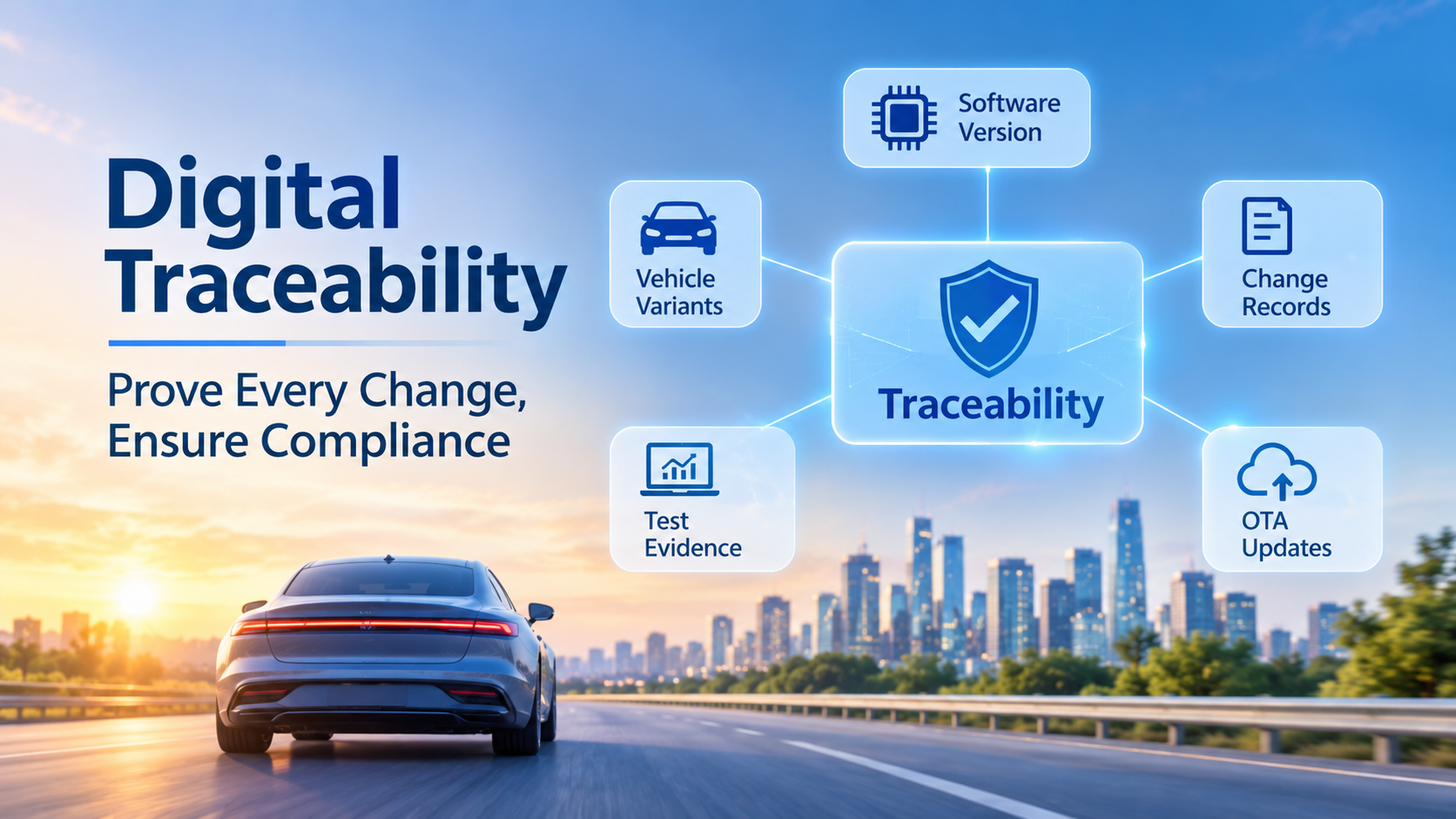
Why Future Vehicle Certification Will Depend On Digital Traceability
Why Future Vehicle Certification Will Depend On Digital Traceability
If you can't prove the change...
You may not be able to prove compliance.
For many years, automotive certification focused on one simple question:
Does the product comply?
Today, the question is changing.
As vehicles become software-defined, connected and continuously updated, regulators, OEMs and customers increasingly want to know something else:
Can you prove what changed?
That is why Digital Traceability is becoming one of the most important capabilities in modern Vehicle Compliance.
Vehicles are no longer static products
Traditionally, a vehicle was validated before production.
Once approved, it changed very little.
Today, that model no longer reflects reality.
Modern vehicles continue to evolve through:
OTA updates
Software improvements
Security patches
New digital features
Cloud services
AI-enabled functions
The vehicle delivered today may not be identical to the same vehicle six months later.
This changes the meaning of compliance.
Compliance now depends on change history
Imagine a customer reports an issue after an OTA update.
The first question is no longer:
"Did the product pass testing?"
Instead, engineering teams often ask:
Which software version was installed?
What changed?
Which supplier provided the update?
Which vehicle variants received it?
Was additional validation completed?
Without clear answers, solving the issue becomes difficult.
More importantly, demonstrating continued compliance becomes difficult as well.
Documentation is becoming digital
Many organizations still rely on disconnected documents and spreadsheets.
But future vehicle programs require something more dynamic.
Engineering teams increasingly need digital records that connect:
Software versions
Hardware configurations
Test results
Validation history
Supplier updates
Vehicle variants
Technical documentation
Instead of isolated documents, organizations need connected information.
This is the foundation of Digital Traceability.
Configuration Management and Traceability go together
Traceability is not only about recording changes.
It is about understanding their impact.
For example:
A supplier updates one communication module.
Engineering teams should immediately know:
Which vehicles use that software?
Which markets are affected?
Which technical files require revision?
Which validation activities should be repeated?
Without strong Configuration Management, answering these questions becomes slow and risky.
With good traceability, decisions become faster and more reliable.
Digital Traceability supports the entire software lifecycle
As software becomes central to vehicle development, every change should be traceable throughout its lifecycle.
That includes:
Initial development
Validation
Production release
OTA deployment
Maintenance
Future updates
This is why Software Lifecycle management is becoming closely connected to compliance.
The goal is not only to develop software.
It is to demonstrate confidence in every software change.
The future of certification is continuous evidence
Vehicle certification is evolving.
Instead of proving compliance only once, organizations increasingly need to demonstrate that compliance is maintained throughout the product lifecycle.
That requires evidence such as:
Version history
Change records
Validation reports
Configuration history
Update approvals
Traceability between software and hardware
Future compliance will rely not only on testing results, but also on the ability to prove that every significant change has been understood, evaluated and controlled.
Five questions every engineering team should ask
Before the next software release, consider:
✅ Can every software change be traced to a specific version?
✅ Can affected vehicle variants be identified immediately?
✅ Are configuration records always up to date?
✅ Can validation evidence be linked to each software release?
✅ Could you explain every major change during an OEM or regulatory audit?
If the answer is "no" to any of these questions, your traceability process may need strengthening.
Final Thoughts
The future of Vehicle Compliance is not only about passing tests.
It is about proving control.
As vehicles become increasingly connected and software-driven, organizations will need more than successful validation reports.
They will need reliable Digital Traceability that connects software, hardware, documentation and lifecycle management into one continuous compliance process.
Because in the next generation of automotive engineering, success will not depend only on what changed.
It will depend on whether you can prove it.
Join the discussion
How is your organization managing software traceability today?
Do you believe Digital Traceability will become as important as testing itself in future vehicle certification?
I'd love to hear your thoughts in the comments.
 博客
Why Future Vehicle Certification Will Depend O
阅读文章
 博客
Why SASO 2938 Is Becoming a Software Validatio
阅读文章
 博客
SASO 2938 vs GSO 2693: What the 2026 GCC DAB+
阅读文章
 博客
Your UWB Digital Key Passed RF Testing. Is It
阅读文章
 博客
FCC Equipment Authorization: Key Inputs to Pre
阅读文章
 博客
Preparing Project Information and Responsibili
阅读文章

 4000259520