
 English
 Français
 Español
 日本語
 العربية
 繁体中文

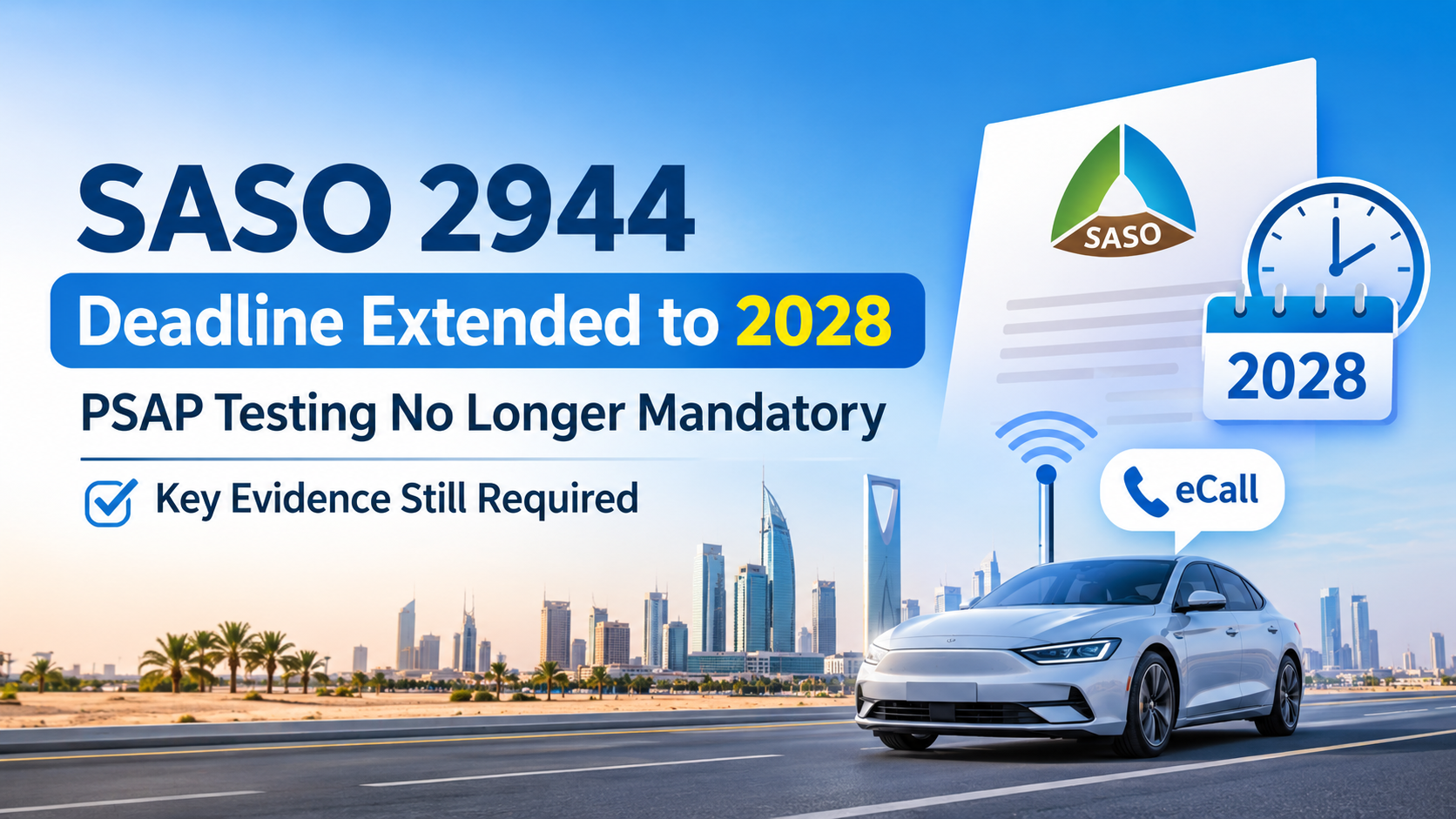
Saudi SASO 2944 Mandatory Date Delayed to 2028: What Evidence Must eCall Manufacturers Still Prepare After PSAP Testing Is Removed?
Saudi SASO 2944 Mandatory Date Delayed to 2028: What Evidence Must eCall Manufacturers Still Prepare After PSAP Testing Is Removed?
The deadline has moved. PSAP testing is no longer mandatory. But does that mean manufacturers can put Saudi eCall compliance on hold? Absolutely not.
Saudi Arabia has made two important changes to its vehicle emergency call requirements under SASO 2944:2023:
The mandatory implementation date has been postponed from 1 January 2027 to 1 January 2028.
Public Safety Answering Point (PSAP) interoperability testing is no longer a mandatory part of the SASO 2944:2023 conformity assessment procedure, effective from the July 2026 notice.
For automotive manufacturers, eCall system developers, T-box suppliers and vehicle electronics manufacturers, these changes provide additional preparation time and remove one specific testing requirement.
However, they do not remove the manufacturer's responsibility to demonstrate compliance with the applicable technical requirements.
The critical question is no longer simply whether a PSAP test is required. It is whether your eCall system can still demonstrate reliable emergency-call functionality through appropriate technical evidence.
1. What Exactly Changed in the 2026 SASO Notice?
On 16 July 2026, SASO announced adjustments to the implementation arrangements for SASO 2944:2023.
The main changes are:
| Requirement | Previous arrangement | Updated arrangement |
|---|---|---|
| Mandatory date | 1 January 2027 | 1 January 2028 |
| PSAP testing | Required in the previous assessment arrangement | No longer mandatory in the SASO 2944 conformity assessment procedure |
| Technical compliance | Manufacturer responsibility | Manufacturer responsibility remains |
| Supporting documentation | Required | Still required |
The revised implementation date applies to all vehicle model types covered by the standard.
Importantly, the notice does not state that the technical requirements of SASO 2944:2023 have been suspended. Manufacturers must still demonstrate compliance with the applicable provisions of the standard and relevant CST technical regulations, including SASO-CST-RI120, which replaces the previous SASO-CST-RI056 reference.
This distinction matters.
Removing mandatory PSAP testing does not automatically eliminate the need to verify emergency triggering, mobile network connectivity, voice communication, positioning, Minimum Set of Data (MSD), or system reliability.
In other words, the assessment route has changed—not the fundamental purpose of eCall.
2. What Does Removing PSAP Testing Actually Mean?
A PSAP is the Public Safety Answering Point responsible for receiving emergency calls and coordinating emergency responses.
In an eCall system, the vehicle automatically or manually initiates an emergency call. The system establishes a communication session and transmits relevant vehicle and incident information.
Previously, PSAP-related testing could involve coordination with an external response-point environment to verify the end-to-end communication process.
Following the 2026 update, this PSAP interoperability test is no longer a mandatory element of the SASO 2944 conformity assessment procedure.
However, manufacturers should not interpret this as permission to skip all functional validation.
There are still important technical questions:
Can the system initiate an emergency call when the required trigger conditions occur?
Can it establish a cellular connection under the intended operating conditions?
Is the MSD correctly generated and transmitted?
Can the system support the required voice communication?
Does the system maintain sufficient backup power?
Can the system identify internal failures and alert the driver?
These questions can be addressed through appropriate laboratory testing, engineering validation and technical documentation without assuming that a live PSAP connection is mandatory.
PSAP testing and eCall functional verification are not interchangeable concepts.
The former concerns interaction with an emergency response endpoint. The latter concerns whether the vehicle's emergency communication system performs its required technical functions.
3. Five Core Evidence Areas Manufacturers Should Still Prepare
Even without mandatory PSAP testing, manufacturers should establish a structured technical evidence package.
The following five areas are particularly important.
1. eCall System Architecture and Technical Documentation
Manufacturers should prepare a clear description of the complete eCall system.
This should identify:
eCall control unit and communication module
GNSS receiver and antenna configuration
Cellular modem and supported network technologies
Microphone, speaker and audio signal paths
Crash detection and emergency triggering interfaces
Backup power supply and battery arrangement
Interfaces with the vehicle electronic architecture
The documentation should explain how these components interact during an emergency event.
A wireless module datasheet alone is insufficient to demonstrate the functionality of the complete vehicle eCall system.
2. Emergency Triggering and MSD Evidence
Automatic emergency triggering is one of the most important eCall functions.
Manufacturers should maintain evidence showing how the system responds to relevant crash signals and how the triggering strategy is validated.
The MSD (Minimum Set of Data) also requires careful verification.
Depending on the applicable requirements, the data package may include:
Vehicle identification information
Vehicle type and relevant vehicle characteristics
Current location and relevant recent location information
Event timestamp
Automatic or manually initiated call status
Other required incident-related information
The manufacturer should verify data structure, accuracy, encoding and transmission.
Incorrect VIN information, missing fields, invalid timestamps or inaccurate GNSS positioning can undermine the reliability of the emergency communication function.
3. Cellular Communication and RF Test Evidence
An eCall system depends on mobile network connectivity.
Manufacturers must consider the supported cellular technologies, operating frequency bands, antenna configuration and communication performance.
Relevant evidence may include:
RF transmitter and receiver performance
Supported frequency bands and operating modes
Antenna configuration and integration information
Network registration and connection behaviour
Communication stability under defined test conditions
Applicable SAR assessment, where required
The exact test scope depends on the product configuration and applicable CST requirements.
A cellular module with an existing RF report does not automatically prove that the complete vehicle eCall installation is compliant.
Antenna placement, cable losses, vehicle body shielding, power supply noise and integration with other vehicle electronics can all affect communication performance.
4. EMC, Electrical Safety and Power Supply Evidence
An eCall system must remain functional in a demanding automotive electrical environment.
The evidence package should address relevant electromagnetic compatibility and electrical safety requirements.
Key engineering considerations include:
Conducted and radiated electromagnetic emissions
Immunity to conducted and radiated disturbances
Electrical transients and supply voltage variations
Grounding and shielding
Power supply stability
Backup battery performance
Backup power deserves particular attention.
After a collision, the vehicle's main electrical supply may be interrupted or damaged. The eCall system must therefore be designed and validated according to the applicable backup-power requirements.
Manufacturers should maintain test records covering the relevant power interruption scenarios, operating duration and communication functions.
A system that works perfectly during normal vehicle operation may still fail when its main power supply is disconnected.
5. Self-Test, Fault Indication and System Reliability
An eCall system should not simply work when an emergency occurs. It should also be capable of identifying relevant internal failures.
Manufacturers should prepare evidence covering:
Power-up self-test functionality
Detection of communication module faults
GNSS and antenna connection monitoring
Backup power status
Fault indication to the driver
Diagnostic information and system recovery behaviour
The technical documentation should explain what the system monitors, how faults are detected and how the driver is informed.
This is especially important for integrated T-box and telematics platforms, where eCall shares hardware or software resources with other vehicle connectivity functions.
4. Do Existing CST Wireless Approval Reports Still Matter?
Yes.
Another important point is that SASO 2944 compliance and CST wireless type approval should not be treated as the same approval process.
For products requiring CST wireless type approval, manufacturers may still need the applicable RF, SAR, EMC and electrical safety test reports, together with relevant technical documentation.
These requirements depend on the product category, radio functions and applicable CST regulatory route.
For example, an automotive T-box may integrate:
LTE or other cellular communication
Bluetooth
Wi-Fi
GNSS
Multiple antennas
Vehicle communication interfaces
Each radio function and applicable regulatory requirement should be assessed according to the product configuration.
The postponement of SASO 2944 does not automatically exempt these wireless functions from their own approval requirements.
Manufacturers should therefore maintain two clearly separated evidence streams:
Stream A – Wireless and ICT compliance
RF test reports
SAR assessment, where applicable
EMC test reports
Electrical safety evidence, where applicable
CST technical documentation and approval records
Stream B – Vehicle eCall compliance
eCall system architecture
Emergency triggering validation
MSD verification
GNSS positioning evidence
Cellular communication functionality
Backup power validation
Self-test and fault indication evidence
Relevant SASO 2944 technical documentation
Keeping these evidence packages separate but technically consistent can reduce duplicated testing and documentation gaps.
5. Why Manufacturers Should Not Wait Until 2027 to Prepare
The new mandatory date is 1 January 2028. However, automotive development and approval cycles often take much longer than expected.
Waiting until the final months of 2027 can create several risks.
Risk 1: Hardware changes trigger additional validation.
Changing a cellular module, antenna, backup battery or eCall ECU may affect previously completed test results.
Risk 2: Software updates affect system functionality.
Changes to emergency triggering logic, GNSS processing, MSD generation or communication protocols may require additional regression testing.
Risk 3: Wireless and vehicle-level evidence may not match.
A module's RF report may refer to a different antenna, firmware version or hardware configuration from the final vehicle installation.
Risk 4: Missing technical documentation delays assessment.
Even when a specific external test is no longer mandatory, incomplete architecture descriptions, test records and configuration information can still create review problems.
A better strategy is to complete a technical gap assessment before the vehicle configuration is frozen.
6. A Practical Preparation Checklist for 2027–2028
We recommend that manufacturers and suppliers establish the following preparation sequence:
| Preparation stage | Key actions |
|---|---|
| Regulatory review | Confirm SASO 2944:2023 and applicable CST requirements |
| Product configuration | Freeze eCall ECU, modem, antenna and backup power configuration |
| Technical review | Check architecture, triggering, MSD and communication functions |
| Laboratory validation | Plan applicable RF, EMC, SAR and electrical safety testing |
| Functional verification | Validate GNSS, voice, emergency triggering, backup power and self-test |
| Documentation | Consolidate reports, technical descriptions and configuration records |
| Final assessment | Confirm the applicable conformity assessment procedure and evidence package |
The removal of mandatory PSAP testing may simplify one part of the assessment process, but it does not eliminate the need for a technically complete eCall solution.
7. How BlueAsia Labs Supports Saudi eCall Compliance Preparation
For automotive manufacturers, the challenge is rarely just obtaining one test report.
The real challenge is coordinating wireless performance, EMC, electrical safety, system functionality and vehicle integration into one consistent compliance strategy.
At BlueAsia Labs, our automotive and IoV testing capabilities support manufacturers and suppliers working on:
Saudi SASO 2944 eCall compliance preparation
RF testing for cellular, Bluetooth and Wi-Fi functions
EMC testing for automotive electronic products
SAR assessment where applicable
Wireless module and antenna integration evaluation
eCall system pre-assessment and technical evidence review
Automotive electronic product validation
Our in-house RF, EMC, safety and automotive testing capabilities help customers identify potential technical gaps before formal assessment.
We focus on more than individual test results: our objective is to help manufacturers align product configuration, test evidence and technical documentation to reduce avoidable retesting and market-entry delays.
Final Takeaway: One Year More, But Not One Year Less of Preparation
The 2026 SASO update gives manufacturers additional time and removes mandatory PSAP interoperability testing from the SASO 2944 conformity assessment procedure.
But three responsibilities remain clear:
The applicable technical requirements of SASO 2944:2023 still need to be addressed.
Relevant CST wireless and technical regulatory requirements still apply.
Manufacturers must maintain sufficient test reports, technical documentation and supporting evidence.
The best use of the additional year is not to delay eCall development. It is to complete the technical validation and evidence package before the 2028 mandatory deadline.
Is your eCall system ready for Saudi Arabia?
Contact BlueAsia Labs to review your eCall architecture, RF/EMC test scope and technical documentation before your next certification or vehicle approval milestone.
 博客
Why Multi-Market Vehicle Development Is Replac
阅读文章
 博客
The Biggest DAB+ Problem Isn't Reception.
阅读文章
 博客
Saudi SASO 2944 Mandatory Date Delayed to 2028
阅读文章
 博客
Your Motorcycle Has Bluetooth, Wi-Fi and a Con
阅读文章
 博客
Bluetooth BQB: What Product Teams Should Clari
阅读文章
 博客
From 2G/3G to 4G/5G: What EU eCall Regulation
阅读文章

 4000259520