
 English
 Français
 Español
 日本語
 العربية
 繁体中文

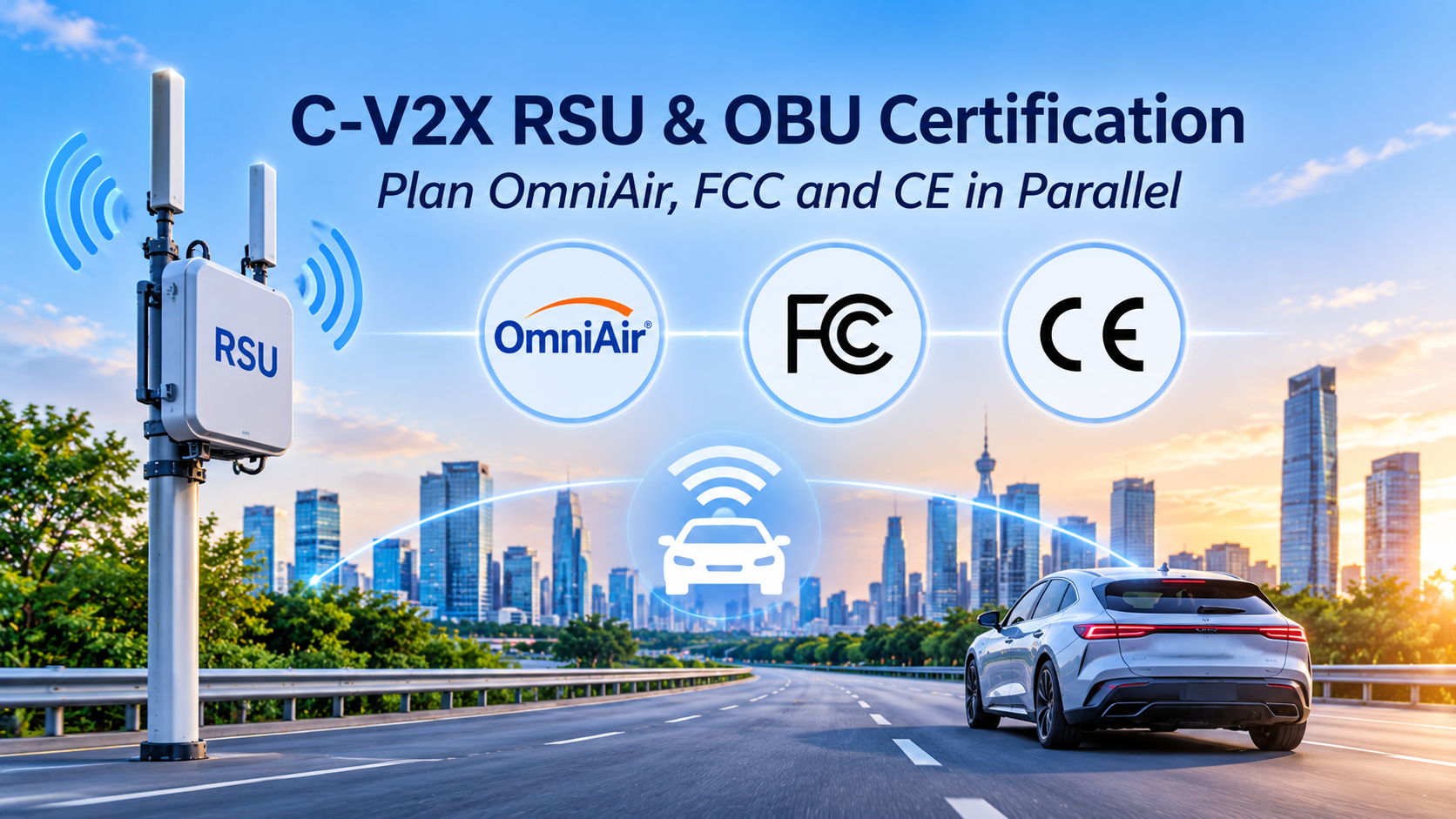
C-V2X RSU & OBU Certification: How to Plan OmniAir, FCC and CE in Parallel
Your C-V2X RSU or OBU may be technically ready—but is it ready for the U.S. or European market?
For intelligent transportation and connected-road projects, manufacturers often face three different requirements at the same time:
FCC. CE/RED. OmniAir Certification.
They are sometimes treated as three versions of the same certification.
They are not.
FCC and CE/RED address regulatory market access. OmniAir addresses C-V2X interoperability and industry certification.
Understanding this difference early can prevent duplicated testing, wrong test configurations and unexpected delays when an RSU or OBU moves from engineering validation to commercial deployment.
1. First: What Does Each Certification Actually Prove?
Think of the compliance strategy as three layers.
Layer 1 — Regulatory Compliance
For the United States, the product must satisfy applicable FCC requirements for its radio operation and intended deployment.
For Europe, the equipment may fall under the Radio Equipment Directive (RED) 2014/53/EU, together with applicable harmonised standards and other relevant EU requirements.
These are regulatory market-access obligations.
Layer 2 — C-V2X Interoperability
This is where OmniAir Certification becomes important.
OmniAir provides independent third-party certification for C-V2X RSUs, OBUs and modules, with testing covering interoperability, conformance, security and performance.
An OmniAir certificate should therefore not be described as a replacement for FCC or CE.
It answers a different question:
Can this V2X device reliably operate and interoperate within the expected connected-vehicle ecosystem?
Layer 3 — Deployment and Customer Requirements
Transportation agencies, infrastructure operators and automotive OEMs may impose additional technical requirements.
In some projects, an OmniAir-certified device may be strongly preferred—or explicitly requested in procurement specifications.
OmniAir notes that its certification can support eligibility for procurements requiring certified products.
So the commercial requirement may be stricter than the basic legal requirement.
2. The U.S. C-V2X Path Has Changed
This is particularly important for manufacturers targeting the United States.
The FCC adopted new rules in November 2024 to transition U.S. 5.9 GHz ITS operations from DSRC toward C-V2X, and the final C-V2X technical rules became effective on February 11, 2025.
This means an American C-V2X product strategy should no longer be based simply on older DSRC assumptions.
For an RSU or OBU, the engineering team should establish early:
Operating frequency range
Channel bandwidth
Transmit power
Antenna configuration
PC5/C-V2X implementation
RF exposure considerations where applicable
Emissions performance
Software and firmware configuration
Intended FCC authorization route
The key point is that the U.S. radio configuration must be frozen before formal testing.
A later change in power, antenna, frequency configuration or RF hardware can affect the regulatory assessment.
3. Europe Uses a Different Regulatory Logic
Europe has its own C-ITS spectrum and technical framework.
The EU harmonised the 5 875–5 935 MHz band for safety-related ITS applications. The current framework also provides specific conditions for road ITS use in different parts of the band.
For C-V2X products, ETSI has developed dedicated technical specifications.
For example:
ETSI EN 303 613 defines the LTE-V2X access layer for ITS operating in the 5 GHz band.
The newer ETSI EN 303 798 extends this framework to LTE-V2X and NR-V2X, including 5G-based V2X technology.
This creates an important difference from the U.S. approach.
A product cannot simply take its U.S. C-V2X configuration, change the label and assume it is ready for Europe.
The manufacturer needs to review:
Frequency + channelisation + RF parameters + harmonised standards + RED assessment + market configuration.
4. Europe Is Also Moving Toward Wider C-V2X Channels
There is another development manufacturers should watch closely.
In July 2026, the European Commission adopted Implementing Decision (EU) 2026/1800, amending the 5.9 GHz ITS spectrum framework to introduce wider frequency channels for safety-related road ITS applications.
The decision supports the introduction of 20 MHz channels in part of the 5.9 GHz range, alongside existing 10 MHz channel arrangements.
For future C-V2X product platforms, this is important because RF architecture decisions made today may need to support more than one channel configuration.
Manufacturers should therefore avoid designing the RF front end around a single deployment scenario without checking the target market's roadmap.
5. OmniAir Is Not Just Another RF Test
This is one of the most important points for product managers.
An RF laboratory can determine whether the device meets specified radio parameters.
OmniAir goes further into the connected-vehicle communication ecosystem.
Current OmniAir C-V2X certification programs cover:
RSUs
OBUs
C-V2X modules
Communication protocols
Message handling
Interoperability
Security services
Performance
Relevant V2X test cases
The certification framework references technologies and standards such as 3GPP LTE-V2X, SAE J2735, SAE J3161, IEEE 1609.2 and IEEE 1609.3, depending on the device and certification scope.
This is why a product can pass its RF regulatory testing and still require additional interoperability work before OmniAir certification.
6. RSU and OBU Should Not Be Planned the Same Way
Although both devices use C-V2X, their integration environments are different.
RSU
The RSU is installed in roadside infrastructure.
Engineering teams need to consider:
Pole/cabinet installation
Outdoor environmental conditions
Antenna and cable configuration
Ethernet/network interfaces
GNSS timing
Power supply
Traffic signal interfaces
NTCIP or project-specific interfaces
Security and remote management
OmniAir specifically positions RSU certification around interoperability with certified OBUs and other connected-vehicle infrastructure.
OBU
The OBU is installed in the vehicle.
The critical factors become:
Vehicle power supply
Antenna position
Vehicle grounding
CAN/Ethernet interfaces
GNSS
Vehicle data
EMC environment
Vehicle-level integration
Software and application behaviour
Therefore, one C-V2X radio platform does not automatically mean one identical certification strategy for RSU and OBU.
7. The Biggest Mistake: Testing Too Early With the Wrong Configuration
A typical project may look like this:
Prototype → FCC test → CE test → OmniAir test → Customer deployment
The problem is that the configuration may change between each stage.
For example:
Engineering antenna → FCC antenna → EU antenna → customer antenna
or:
Firmware V1.0 → FCC V1.2 → OmniAir V1.5 → production V2.0
Every change creates a potential compliance question.
For C-V2X products, we recommend establishing a Configuration Control Matrix covering:
Hardware version
RF chipset
PA/LNA
Antenna
Cable
Frequency
Channel bandwidth
Transmit power
Firmware
Protocol stack
Security software
GNSS
Interfaces
Country/region configuration
This matrix should be established before formal testing begins.
8. A Better Parallel Certification Strategy
Instead of treating FCC, CE and OmniAir as three independent projects, manufacturers can plan them in parallel.
Phase 1 — Architecture Review
Define:
U.S. configuration + EU configuration + OmniAir target profile
before PCB and RF hardware are frozen.
Phase 2 — RF Pre-Compliance
Validate:
Output power
Occupied bandwidth
Spurious emissions
Receiver performance
Antenna matching
EMC
GNSS coexistence
Phase 3 — Regulatory Testing
Prepare the applicable:
FCC + RED/CE
test programme according to the final market configuration.
Phase 4 — OmniAir Pre-Validation
Use the target OmniAir certification scope to identify interoperability and protocol gaps before formal certification.
OmniAir recommends Plugfest participation as a way to validate interoperability before conformance certification testing.
Phase 5 — Final Certification and Deployment
Only after hardware, firmware, RF configuration and protocol behaviour are controlled should the final certification package be locked.
9. What Should C-V2X Manufacturers Ask Before Starting?
Before requesting a quotation, answer these questions:
1. Is the product an RSU, OBU or module?
2. Which countries will the product be deployed in?
3. Which C-V2X release and frequency configuration are required?
4. Is FCC authorization required for the intended U.S. deployment?
5. Which RED harmonised standards apply to the European configuration?
6. Does the customer or transportation agency require OmniAir Certification?
7. Will the same antenna and firmware be used for all markets?
8. Does the product require additional EMC, cybersecurity or environmental testing?
These answers determine the real certification scope.
Build the Certification Roadmap Before the RSU/OBU Is Frozen
For intelligent transportation projects, the most efficient strategy is not:
FCC → CE → OmniAir → redesign
It is:
Market requirements → RF architecture → regulatory gap assessment → pre-test → FCC/CE testing → OmniAir validation → certification → deployment
At BlueAsia Labs, we support connected mobility and IoT products through integrated RF, EMC, wireless, Bluetooth, IoT and automotive compliance testing.
For C-V2X RSU, OBU and module manufacturers, our team can help map the U.S. and European requirements at the beginning of the project and identify where FCC, CE/RED and OmniAir testing can be coordinated rather than duplicated.
The earlier the certification architecture is defined, the less likely a V2X product is to reach final testing with the wrong RF configuration or an unexpected interoperability gap.
 博客
Why Software Updates Are Creating Supplier Man
阅读文章
 博客
Why Certification Engineers Need to Think Like
阅读文章
 博客
C-V2X RSU & OBU Certification: How to Plan
阅读文章
 博客
Your Base Vehicle Is Already R155 Approved. Wh
阅读文章
 博客
Planning Wireless Certification Before Product
阅读文章
 博客
Understanding the MFi Program in a CarPlay Pro
阅读文章

 4000259520