
 English
 Français
 Español
 日本語
 العربية
 繁体中文


Automatic and Manual eCall Activation: What Can Go Wrong at the Trigger Stage?
Contact:Olivia
Email: [email protected]
WhatsApp: +8617663606879
Website:https://blueasialabs.com/
For an in-vehicle emergency call system, initiating an emergency call is only the beginning. What happens if the system fails to detect a serious accident, triggers unnecessarily, or does not respond correctly when the driver manually activates it?
For automotive OEMs and Tier 1 suppliers, the reliability of the eCall activation mechanism is an essential part of vehicle safety and type-approval preparation.
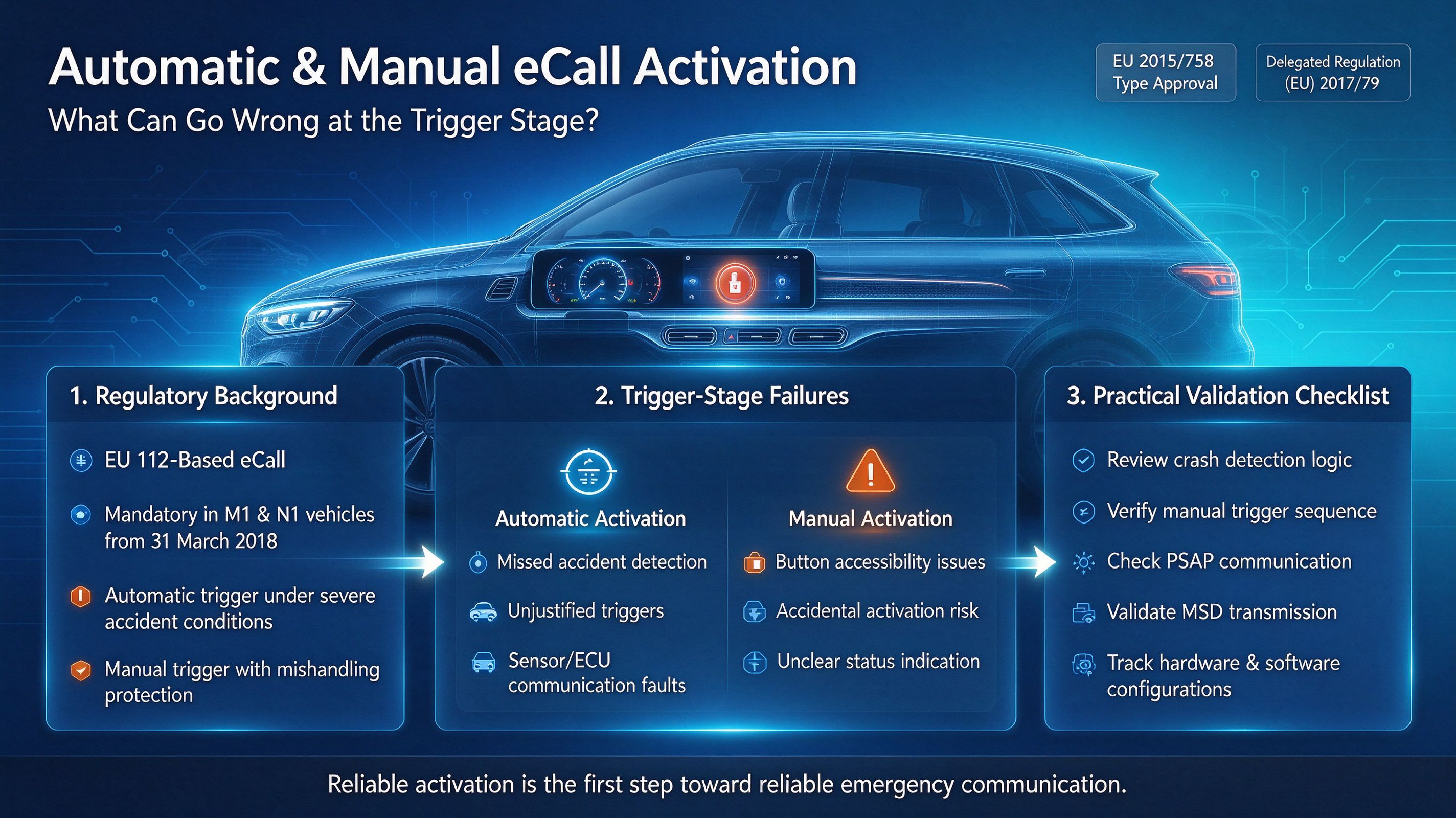
1. Regulatory Background: EU 112-Based eCall
Regulation (EU) 2015/758 establishes type-approval requirements for the deployment of 112-based eCall in-vehicle systems.
The regulation requires 112-based eCall systems to be fitted in all new types of M1 and N1 vehicles from 31 March 2018.
Under Article 5, manufacturers must demonstrate that:
An eCall to the European emergency number 112 is automatically triggered when a severe accident is detected by one or more in-vehicle sensors or processors.
The system also allows an emergency call to be initiated manually.
The manual trigger control is designed to avoid mishandling.
The detailed technical requirements and test procedures are further established in Commission Delegated Regulation (EU) 2017/79.
2. What Can Go Wrong at the Trigger Stage?
Although automatic and manual activation serve the same emergency communication purpose, they involve different activation mechanisms and potential failure scenarios.
A. Automatic Activation: Missed or Unjustified Triggers
Automatic eCall activation depends on the vehicle's accident detection strategy.
Potential engineering concerns include:
Failure to recognize certain accident configurations.
Inappropriate triggering following impacts that do not represent severe accidents.
Hardware or software faults affecting the activation logic.
Inconsistent communication between crash sensors, control units and the eCall system.
Annex V of Regulation (EU) 2017/79 specifically addresses the manufacturer's automatic triggering strategy. It requires supporting technical documentation, including the approach to preventing unjustified eCalls and failure mode analysis demonstrating that hardware or software faults will not result in automatic activation.
B. Manual Activation: Human-Machine Interface Reliability
Manual activation provides another way to initiate an emergency call.
However, the activation control must be designed to avoid mishandling.
From an engineering perspective, manufacturers should pay attention to:
Button accessibility and physical design.
Accidental activation prevention.
Correct response to a deliberate manual input.
Clear visual and/or audible indication of the eCall sequence.
The objective is to ensure that the manual activation function operates as intended without introducing unnecessary false calls.
3. What Happens After the Trigger?
A successful trigger does not automatically mean that the complete eCall process has succeeded.
The system must also establish communication with the appropriate Public Safety Answering Point (PSAP) and transmit the Minimum Set of Data (MSD).
The MSD contains important information, including the incident time, vehicle location and other vehicle-specific information.
The European Commission describes the 112 eCall process as an emergency call that communicates the vehicle's location to emergency services.
Therefore, validation should not stop at checking whether an activation signal has been generated.
The subsequent communication and data transmission functions also deserve attention.
4. Practical Validation Checklist for OEMs and Tier 1 Suppliers
Before completing eCall validation, engineering teams can consider the following checks:
1. Automatic Trigger Logic
Review the relationship between crash detection signals and eCall activation.
Evaluate the manufacturer's selected accident detection strategy.
Review potential false-trigger scenarios and hardware/software failure modes.
2. Manual Trigger Function
Check the physical activation control and its intended operation.
Verify that manual activation initiates the expected eCall sequence.
Review the visual and/or audible status indication.
3. Emergency Communication
Verify that the system can establish communication with the designated PSAP test point.
Check whether the MSD is successfully transmitted and decoded.
Review the accuracy of vehicle-specific information and location data.
4. Software and Hardware Configuration
Maintain records of the hardware and software configurations used during testing.
Review whether changes to relevant components could affect the validated functions.
Determine whether additional verification is necessary before project approval.
The first three areas relate to the regulatory requirements and associated test procedures. Configuration tracking and additional regression checks are recommended engineering and project-management practices.
5. Why Trigger-Stage Validation Matters
For automotive manufacturers, eCall validation should be approached as an integrated process rather than an isolated button or sensor test.
A reliable system needs to identify the appropriate activation conditions, respond correctly to manual input, and successfully complete the emergency communication process.
Early identification of potential issues can help engineering teams reduce late-stage modifications and improve the efficiency of type-approval preparation.
At Blue Asia, we work in the field of automotive electronics testing and certification. If your team is preparing an eCall-related project or reviewing automotive electronic compliance requirements, feel free to contact us to discuss your project needs.
Reliable activation is the first step toward reliable emergency communication.
Contact:Olivia
Email: [email protected]
WhatsApp: +8617663606879
Website:https://blueasialabs.com/
 博客
What Happens If CarPlay Hardware or Firmware C
阅读文章
 博客
Automatic and Manual eCall Activation: What Ca
阅读文章
 博客
Android Auto Testing Standards and Test Items
阅读文章
 博客
CarPlay Testing Standards and Test Items
阅读文章
 博客
EU eCall Type Approval: How Long Is It Valid,
阅读文章
 博客
What Is VCCI Compliance in Japan? Product Scop
阅读文章

 4000259520